How much does college cost? The honest answer is: it depends. Tuition alone can range from a few thousand dollars a year to well over $60,000, once you add in housing, books, and other expenses. Many students find the overall cost of college to be overwhelming. According to the College Ave Spring 2025 Student Survey, 61% of students reported that the cost of college was higher than they expected.
Currently, the average cost at a four-year public school for in-state tuition is $11,610 while out-of-state tuition averages $30,780. However, tuition isn’t the only cost to consider when attending college. Additional college expenses, like housing and books, can add up when calculating the total cost of college, with the average total cost of attendance totaling $38,270 per year.
This guide breaks down exactly what goes into the cost of college in 2025-2026, from tuition and housing to the financial aid options that can bring your total price down.
Key Takeaways
- The average total cost of college in the U.S. is $38,270 per year once tuition, housing, and other expenses are included.
- In-state public tuition averages $11,610 a year, while out-of-state public tuition averages $30,780.
- Grants, scholarships, and federal aid can significantly lower your net price below the advertised sticker price.
- Filling out the FAFSA, and the CSS Profile at some private schools, is the first step to unlocking financial aid.
- Federal and private student loans can help cover any gap between what aid covers and what you still owe.
Average College Tuition & Costs 2024-2025
So, how much does college cost once every expense is on the table? To understand the average college tuition and costs for 2025, it’s important to understand that the average cost of attendance not only includes tuition, but also housing and food, books and supplies, transportation, and other related college expenses.
The following statistics from College Board represent the true cost of college for different school types:
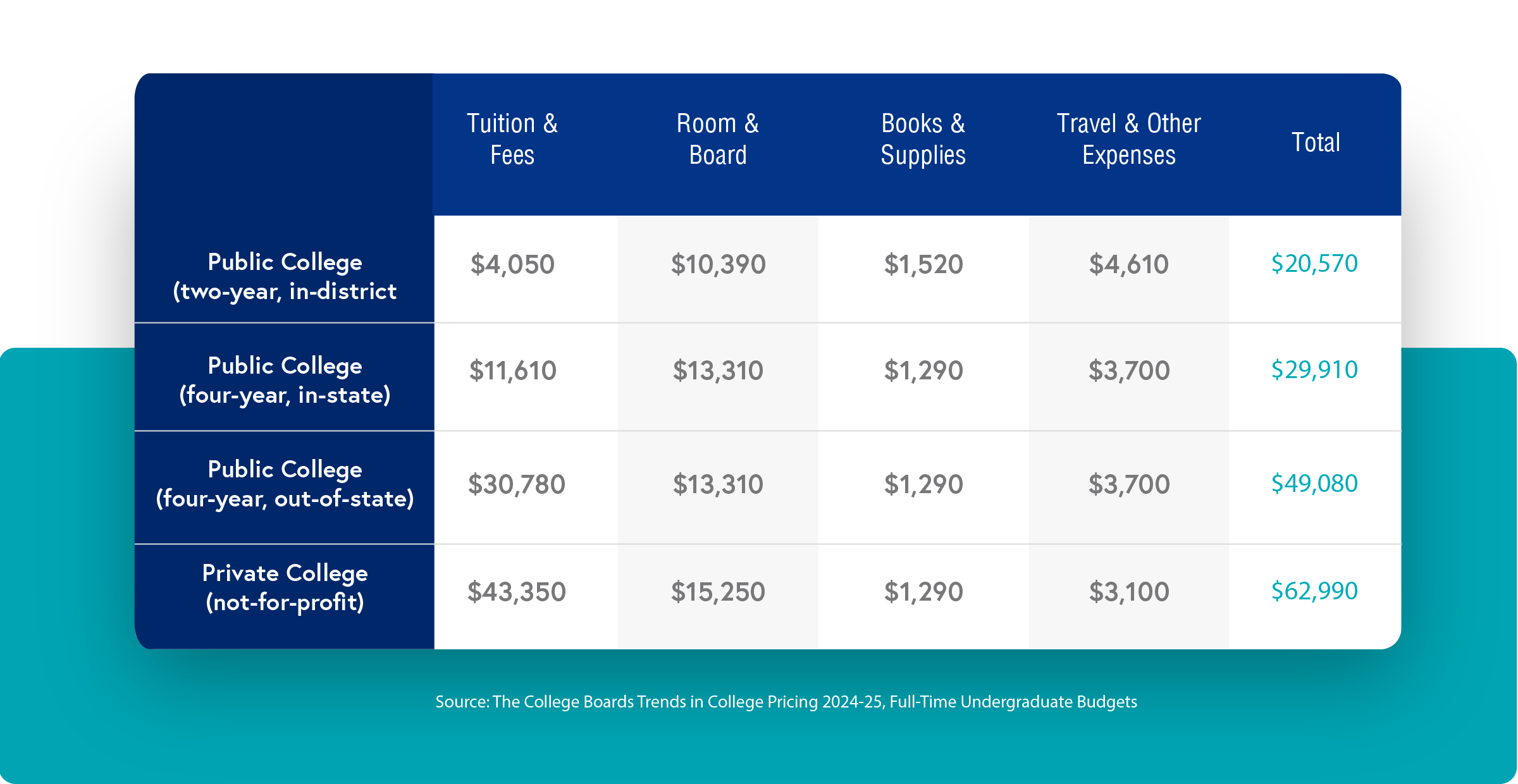
It’s also important to note that while this is the average cost nationwide, the cost will also vary by state. The difference between the most expensive public in-state tuition and the least expensive is roughly $11,130, with the most expensive colleges found in the New England area and the least expensive in Rocky Mountain states like Wyoming and Idaho or the South like North Carolina and Florida.
How Institution Type and Residency Affect Your Cost
Where you go to school changes your total bill more than almost any other single factor. In-district students at public two-year colleges pay the least, followed by in-state students at public four-year schools. Out-of-state students at public universities and students at private nonprofit colleges pay significantly more, since neither group benefits from the state subsidies that keep in-state tuition lower. If you’re weighing schools in different states, it’s worth running the numbers for both residency scenarios before you commit.
Factors in Current Cost of College
There is more to the cost of college than just tuition. Students have to pay for books and supplies, room and board, transportation, food, and much more. These factors vary in price from state to state, but all have continued to increase over the years.
Difference Between Tuition and Fees
Before students attend college, they might not be aware of the difference between tuition and fees. The cost of tuition is a charge directly from the school for teaching. This is usually the most expensive component for attending college. However, other fees and expenses can add up quickly.
Fees, however, vary from school to school. Fees are additional charges on top of the tuition. For example, a school may have a health clinic fee, gym fee, communication fee, technology fee, athletic fee, among others.
Cost of Living Expenses
Beyond tuition and fees, your living expenses in college add to the overall cost of college. This includes books and school supplies, housing and transportation and other miscellaneous living costs such as personal hygiene items, linens, cooking supplies, and basic necessities.
Books and School Supplies
Whether the school is public, private, in-state, or out-of-state, the textbook and school supply costs are all relatively the same. Books and supplies are estimated to cost $1,290 per year for four-year colleges.
Housing
After tuition and fees, housing is the next largest cost of college. Costs can vary greatly, and a deciding factor is whether a student lives on campus, off campus, or at home.
Living on campus is often the most convenient option, as it typically includes both housing and meal plans. This can make budgeting easier, as these costs are bundled together in a single payment. However, living on campus tends to be more expensive than renting off-campus housing, especially in areas where rental prices are relatively low. Almost half of the students surveyed by College Ave lived on campus, with an average monthly housing cost of $1,384.
On the other hand, students who live off campus might have the flexibility to find more affordable accommodations, especially in certain locations or by sharing rental costs with roommates. However, these students still need to account for the cost of food, utilities, and transportation.
A third option, living at home with family while attending a nearby college, is typically the least expensive choice of the three. Students who live at home skip both dorm fees and off-campus rent, though they should still budget for gas or public transit and factor in any time lost to a longer commute.
Budgeting the cost of housing can be difficult as it varies greatly from market to market.
Transportation
Transportation can be a significant part of calculating the cost of attendance and the cost can vary greatly depending on if the student lives on or off campus. Commuters typically spend less than people who live on campus because they do not incur the same housing expenses. However, commuters still have transportation expenses to consider.
Beyond the cost of tuition and fees associated with driving to and from campus, commuters have to budget for gas, car insurance and maintenance, parking and their housing expenses if they live off-campus on their own.
Types of Degrees and Schools
Two other major factors that influence tuition are the types of degrees earned, as well as the types of schools that students attend. For example, the cost of attending an Ivy League school would typically be much higher than attending a community college whereas someone earning a medical degree will usually spend much more on tuition than someone earning a bachelor’s degree.
How Financial Aid Impacts College Cost
Financial aid plays a key role in covering college costs. According to the survey, 53% of students are currently using merit aid, such as scholarships or grants, to pay for their education, which helps alleviate the costs of tuition and more.
Sticker Price vs. Net Price
In simple terms, net price is what you pay after financial aid is factored in, while the sticker price is the cost before any financial aid comes into the picture. The United States Department of Education Scorecard gives detailed information on the net price of specific schools, allowing prospective students to make more informed decisions. This distinction matters because the advertised price is rarely what a student actually ends up owing.
FAFSA
The FAFSA (Free Application for Federal Student Aid) is a form that college students should always complete to see if they’re eligible for school, state and federal financial aid to cover all or a portion of their college expenses. Even if you are unsure if you will qualify for federal aid, it is important for all students to fill out the FAFSA as many schools use it to help determine school specific aid awards.
Some private colleges also require the CSS Profile, a separate financial aid application run by the College Board. It asks for more detailed financial information than the FAFSA, which allows those schools to award their own institutional grants and scholarships. If a school on your list requires it, plan to complete both forms. Once your aid packages arrive, comparing your financial aid award letters side by side will show you the real cost difference between schools.
Grants
A grant is a state or federal program offered to provide college funding for students. Grants are considered free money and typically do not have to be repaid. The federal government uses the FAFSA to determine need based grants, but students should also research grants at the state level to see if they qualify for any local opportunities.
Scholarships
A scholarship is a monetary award given to a student to help pay for college. Typically, scholarships are awarded based on merit, skill, or other specific qualifications and require an application. A scholarship is free money and does not need to be repaid, but there are usually terms and conditions regarding repayment if the student does not complete their degree. Begin applying for scholarships early, understand how scholarships work, and look for specific prizes that meet your unique situation. If you don’t know where to begin, College Ave offers a $1,000 monthly scholarship that any student can apply for.
How Student Loans Impact Cost of College
Student loans often play a part in financing college costs. You’ll want to consider a few different things before choosing a student loan as they typically require repayment with interest.
Federal vs. Private
There are two types of student loans: federal and private. You’ll likely use a mix of both private and federal student loans to pay for college. You’ll receive federal loans by filling out the FAFSA. For some students, the amount of federal aid offered may not be enough to cover all their college expenses. A private student loan can help to bridge that gap; some students find that taking out student loans from private lenders like College Ave allows them to pay for their remaining college costs.
The Cost of Borrowing
Interest rates vary based on the type of loan you take out. With private loans, you may have a more favorable interest rate if you have good credit or cosigner. Before agreeing to borrow a specified amount of money through a student loan, it is important to know just how much the loan will cost you over time, which is based on the interest rate you’re paying.
Calculate Your Costs
Our student loan calculator is an easy to use tool that allows borrowers to calculate just how much they’ll be spending based on the amount they borrow, the loan term, interest rate, years remaining in school, and monthly payments that are made while in school.
Conclusion
There are many different factors to consider when calculating the true cost of college. For many students, it can be easy to overlook some of these expenses, and many of these unanticipated costs often take college students by surprise. Fortunately, students have several options when it comes to paying for college. With a mix of financial aid, grants, scholarships, federal and private student loans, students can pursue higher education and work towards their career goals.
When financial aid and federal loans aren’t enough to cover your college expenses, private student loans are an option students can use to cover any other remaining college expenses that they may have. If you’re still mapping out how to pay for college, a clear step-by-step plan can help you cover the gap between aid and your total bill.
Frequently Asked Questions
How much does 4 years of college cost on average in the US?
Using the current annual averages above, four years at a public, in-state four-year school runs about $154,080 ($38,270 x 4), while four years at a private nonprofit college runs closer to $251,960 ($62,990 x 4). Actual totals vary by school, state, and how much financial aid a student receives.
What college is $90,000 a year?
Costs near $90,000 a year are typically found at elite private universities with high sticker prices, especially in cities with a high cost of living. Very few students pay the full sticker price at these schools, though, since they tend to offer substantial need-based aid that brings the net price down considerably for most families.
Is $500 a month enough for a college student’s living expenses?
It depends on what the $500 needs to cover. If housing and a meal plan are already paid for, $500 a month can realistically cover groceries, transportation, and personal expenses for many students. If it also needs to cover rent or food outside a meal plan, it’s tight in most markets, and students may need to budget carefully or find additional income.
What is the most expensive college in Utah?
Tuition varies by school and program, so the most expensive option in Utah changes based on current-year pricing. Private and out-of-state programs are typically the highest-cost options in any state, including Utah, so it’s worth comparing net price, not just sticker price, across each school you’re considering.